Explore our communities
Discover Ontario’s Most Loved Cottage Regions—from Muskoka to The Kawarthas and Beyond
Parry Sound sits on the eastern shore of Georgian Bay, roughly 225 km north of Toronto, and holds a distinction most buyers don't know until they arrive: it has the deepest natural freshwater port in the world. That geography shaped everything about the place. It is the working gateway to the 30,000 Islands, and it functions as the commercial, medical, and administrative core for a district far larger than its own borders.
The Town of Parry Sound itself is small, with a permanent population in the range of 6,800 to 7,100. But the town is only part of the picture, and confusing the two is the single most common mistake buyers make here. Most of what gets marketed as "Parry Sound real estate" actually sits in the surrounding townships: Seguin, McDougall, Carling, McKellar, Whitestone, and The Archipelago. Those municipalities hold the acreage, the inland lakes, and the islands. The town holds the hospital, the grocery stores, the schools, and the marinas everyone depends on.
Practically, that means you can buy a rural or water-access property with genuine seclusion and still be twenty minutes from a hospital emergency department and a Home Depot. Very few cottage markets in Ontario offer that combination.
The market splits cleanly into three tiers, and each behaves differently.
Segment | Typical Range | What Drives the Price |
|---|---|---|
In-town residential | $400,000 – $650,000 | Municipal water and sewer, natural gas, walkability, older character housing stock |
Township / rural residential | $550,000 – $850,000 | Acreage, privacy, well and septic, trail and lake proximity |
Waterfront (inland and Georgian Bay) | $800,000 – $2,500,000+ | Access type, shoreline exposure, water body, depth and boating capability |
Average days on market typically run between 35 and 65, with meaningful seasonal swing. Waterfront inventory surges in spring and thins by late fall. In-town listings move more evenly year-round because the buyer pool is local and less weather-dependent.
The two halves of this market rarely compete with each other. In-town homes trade near regional medians and are bought largely by full-time residents, retirees, and local families. Waterfront carries a substantial premium and drives district sales volume in dollar terms while representing a much smaller share of transactions. If you're comparing Parry Sound to Muskoka on price alone, know that you're usually comparing two different segments.
In-town homes are single-family detached, townhomes, and small multi-unit properties on municipal services. They appeal to buyers who want the hospital, schools, and shopping within a short drive, and who don't want to manage a well, a septic system, or a private road agreement.
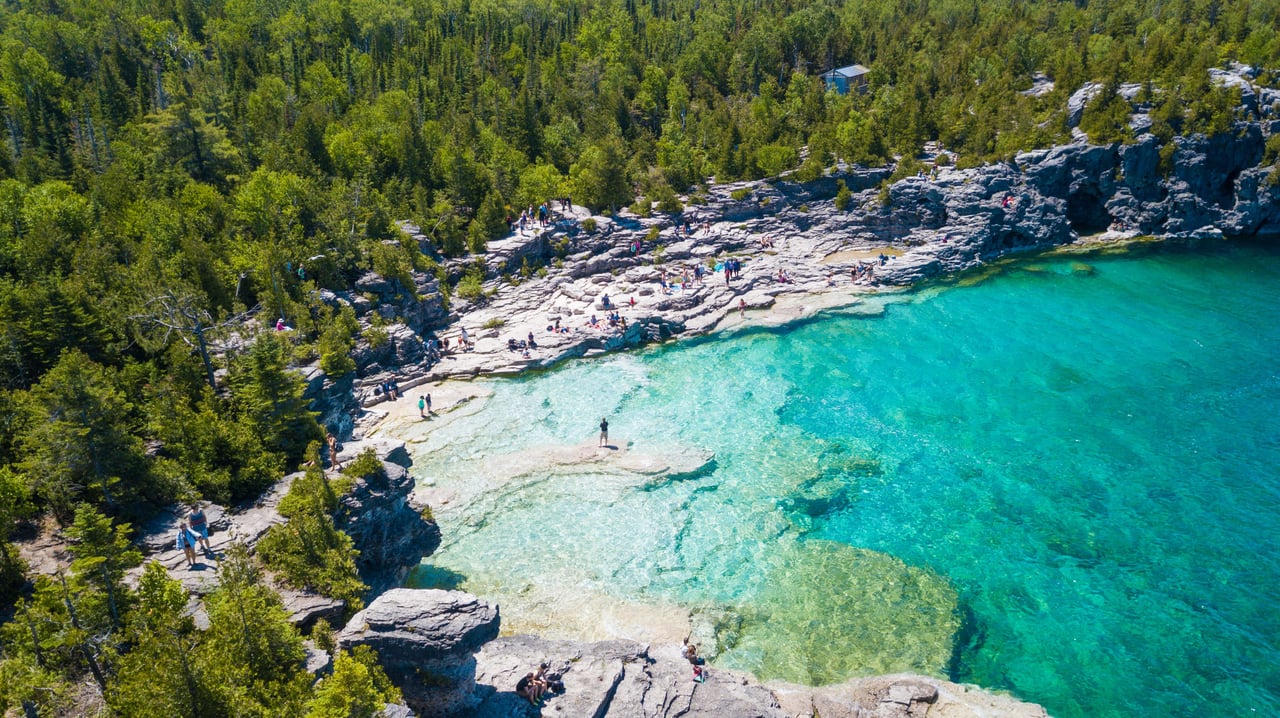
Georgian Bay waterfront is the marquee product: pink granite shoreline, windswept white pines, and deep water close to shore. Deep-water frontage matters enormously here because it accommodates larger boats, and the difference between a shallow, weedy bay and a clean granite drop-off can be hundreds of thousands of dollars on otherwise similar lots.
Island properties across the 30,000 Islands range from rustic one-room cabins to multi-building family compounds. Their value is only partly about the island itself. Mainland parking, a secured slip, and existing off-grid infrastructure (solar, generator, propane, water filtration, holding tank or composting systems) often account for more of the price than square footage does.
Inland lake cottages in Seguin, McDougall, McKellar, and Whitestone sit on lakes like Mill, Otter, Star, and Manitouwabing. They offer warmer swimming, calmer water, sandier shorelines, and road access. Buyers who arrive determined to be on Georgian Bay often end up here once they've spent a windy August afternoon on an exposed bay shoreline.
Vacant land is the most variable category. An in-town serviced lot is straightforward. Rural or waterfront acreage is not. Bedrock blasting, well drilling, septic design, hydro line extension, and environmental setbacks can add well into six figures before a foundation is poured. Always price the build before pricing the land.
The 30,000 Islands is the largest freshwater archipelago on earth, and the surrounding area is recognized as a UNESCO Biosphere. This is the reason people pay a premium here rather than an hour inland.
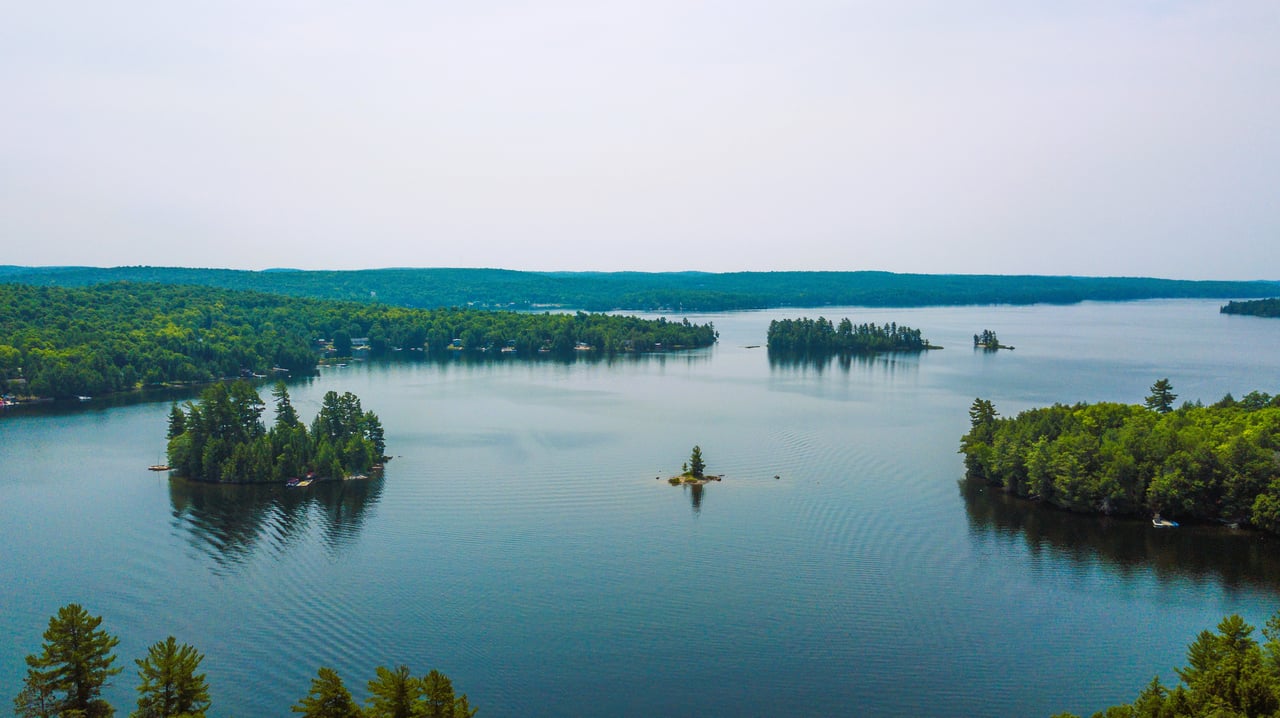
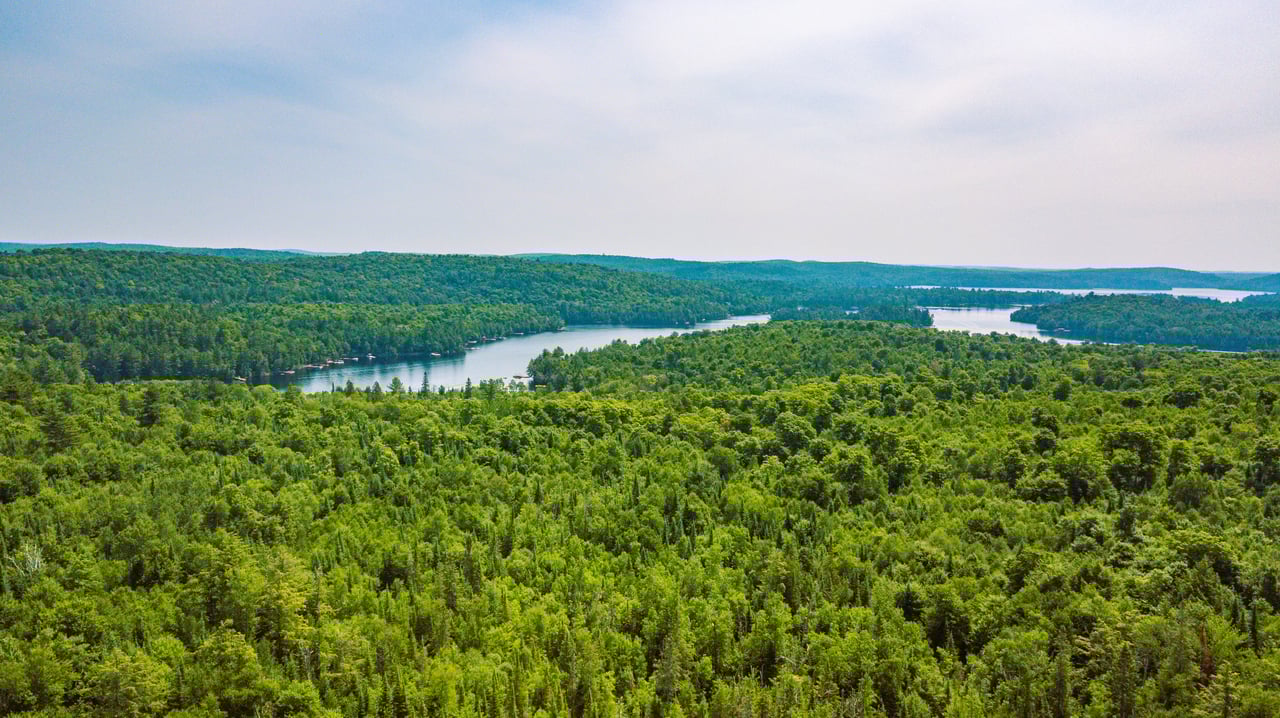
What buyers are actually purchasing is a landscape that cannot be replicated or expanded. The Canadian Shield gives it the exposed granite, the leaning pines, and the open-water horizon that reads instantly as Georgian Bay in any photograph. The deep channels support serious cruising, sailing, kayaking, and fishing, and the sheer number of islands means real seclusion is still available at prices that would buy a modest lot on the Muskoka big three.
That finite shoreline supply is also the investment case. Natural frontage on Georgian Bay is a fixed quantity in a province with a growing population and a durable cultural attachment to cottage ownership. It has historically held value through softer markets better than inland recreational property.
This is the decision that defines a Parry Sound purchase, and it deserves more thought than most buyers give it before their first showing.
Water-access properties generally trade at a 20% to 40% discount to comparable road-access waterfront. For that discount you typically get a larger lot, longer shoreline, and total visual privacy. It is the best value in the district on paper.
The trade-offs are real and ongoing. You will carry mainland parking and slip costs, move every grocery run, propane tank, and sheet of plywood by boat, and haul your own garbage out. Shoulder seasons are the hard part: once ice forms and before it's safe, the property is effectively unreachable, and that window can run from late November through April depending on the year.
Financing changes too. Lenders assess water-access properties as higher risk and commonly require 20% to 35% or more down. Insurance costs more because emergency response is delayed and fire suppression depends on a boat arriving. Neither is a dealbreaker, but both should be confirmed before you write an offer, not after.
If the property is off-grid, budget for the systems as well as the structure. Solar arrays, generators, water intake and filtration, and holding-tank or composting waste systems all have finite lifespans and replacement costs that a standard home inspection won't fully capture.
Area | Character | Best Suited To |
|---|---|---|
Downtown & Waterfront Core | Historic homes, townhouses, waterfront condos; walking distance to shops, cafés, Big Sound Marina, and the waterfront trail | Full-time residents, retirees, buyers who want municipal services |
Seguin Township | High-end inland lakes, four-season executive homes, strong road infrastructure, quick Highway 400 access | Luxury buyers, GTA commuters, warm-water cottagers |
McDougall Township | Wraps the town to the north and east (Mill Lake, Nobel); mix of rural acreage, subdivisions, and small lake cottages | Local families, trades, buyers wanting lower taxes near town |
Carling Township | Northwest along the Bay toward Killbear and Snug Harbour; rugged coastline, deep-water marinas | Boaters and anglers wanting direct open-water access |
The Archipelago | Almost entirely water-access islands and protected coastline | Privacy seekers and traditional island cottagers |
The takeaway: a listing address in "Parry Sound" tells you the postal area, not the municipality. Tax rates, road maintenance responsibility, zoning bylaws, and building permit processes all differ by township, and they affect both your carrying costs and what you're allowed to build.
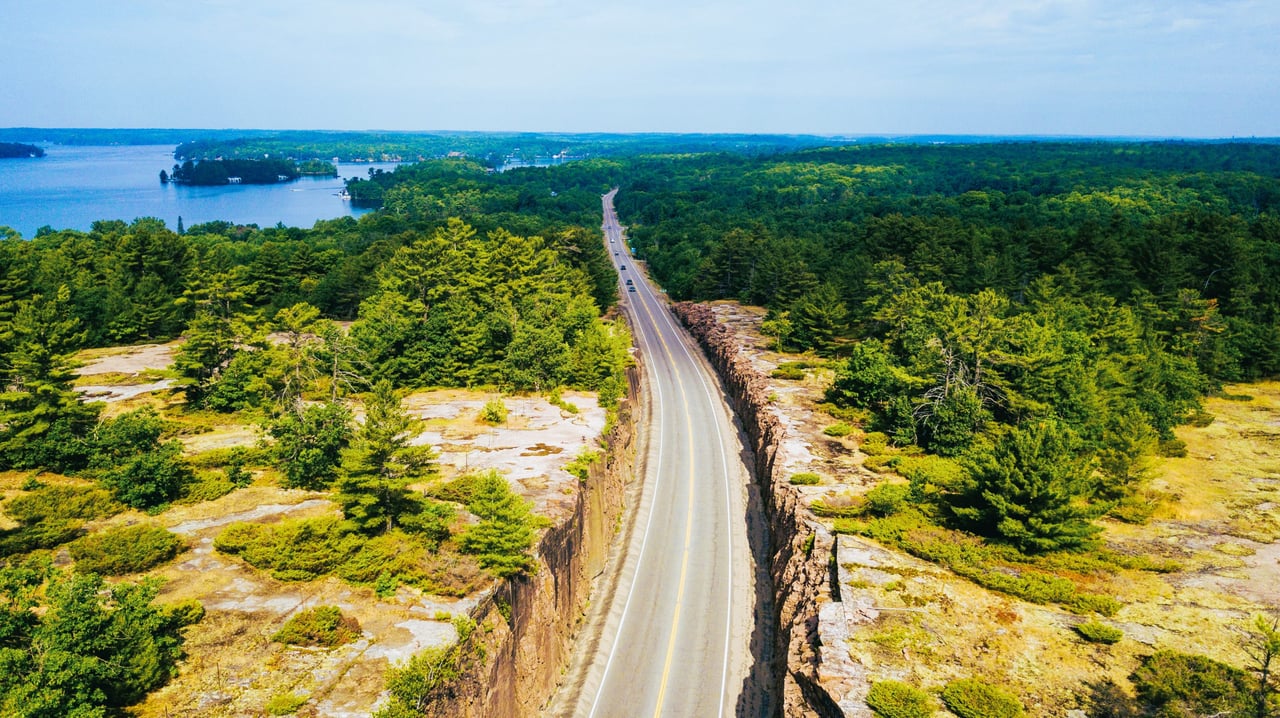
Highway 400 runs straight through the district, which is the practical reason Parry Sound draws GTA buyers who might otherwise stop at Muskoka. The drive from downtown Toronto is roughly two hours and fifteen minutes to two and a half hours in clear conditions. Be honest with yourself about Friday afternoons in July, when northbound traffic can stretch that past three and a half hours.
The Parry Sound Area Municipal Airport (CNK4), fifteen minutes southeast in Seguin Township, has a recently expanded 4,900-foot paved runway handling private charter, corporate aircraft, air ambulance, and general aviation. For buyers at the upper end of the market, this materially changes the weekend calculus.
VIA Rail stops in Parry Sound on select long-distance routes, and Ontario Northland runs daily motor coach service south to Toronto and north to Sudbury and North Bay. Both CN and CPKC operate transcontinental freight lines through town, including over the landmark trestle bridge. Worth knowing if you're buying close to the tracks: freight moves at night.
The Near North District School Board serves the public English system, with Parry Sound Public School (JK–6) and Parry Sound High School (7–12). The high school offers French Immersion and Extended French along with Specialist High Skills Majors in health and wellness and in hospitality and tourism, plus a well-supported regional athletics program.
Catholic elementary education runs through St. Peter the Apostle Catholic School (JK–8) under the Simcoe Muskoka Catholic District School Board; Catholic secondary students generally attend Parry Sound High School or bus toward Bracebridge. Francophone families are served by École Publique aux Quatre-Vents (K–8) through the Conseil scolaire public du Nord-Est de l'Ontario.
Canadore College maintains a West Parry Sound campus offering Practical Nursing, Early Childhood Education, Personal Support Worker, and trades programs, along with continuing education tied to local healthcare and marine employers. A post-secondary presence in a town this size is unusual and speaks to the district's role as a regional hub.
West Parry Sound Health Centre is a modern acute-care hospital overlooking Georgian Bay, with a 24/7 emergency department, surgical services, radiology, CT, dialysis, and inpatient care. Lakeland Long Term Care operates on the same site. Primary care runs through local family health teams and the Nurse Practitioner-Led Clinic network, with dental, physiotherapy, and mental health services available in town.
For daily life, Parry Sound is genuinely self-sufficient. Walmart, Home Depot, Canadian Tire, Sobeys, No Frills, LCBO, and independent hardware and outfitters all operate here year-round. The town has full municipal water and sewer, weekly waste collection, a full-time fire service, an OPP detachment, and a public library.
This is the amenity profile that separates Parry Sound from smaller cottage enclaves where a real grocery run means forty minutes each way.
Boating is the organizing principle. The Big Sound and the channels beyond offer some of the best freshwater cruising in North America, and local full-service marinas provide deep-water slips, fuel, and repair. The Island Queen runs sightseeing cruises through the archipelago for anyone who wants the tour before they buy the shoreline.
Killbear Provincial Park, twenty minutes northwest, delivers the postcard version of Georgian Bay: 12 km of granite and pine coastline, sandy beaches, and excellent kayaking, hiking, and road cycling. Closer to home, the Rotary Algonquin Regiment Fitness Trail runs 3.3 paved kilometres along the inner harbour to Waubuno Beach and is the town's daily walking, running, and sunset route.
Georgian Bay Islands National Park lies south in the archipelago, reachable by boat or water taxi, with protected hiking and island camping.
Winter is not a dead season. OFSC District 10 maintains an extensive groomed snowmobile network connecting toward Sudbury, Muskoka, and Algonquin. Ice fishing, cross-country skiing, and snowshoeing fill out the calendar, with Killbear open for off-season use.
Parry Sound is a working town, not a resort strip, and that distinction is the reason many buyers choose it.
The downtown core around James Street, Seguin Street, and the harbour carries local boutiques, outdoor outfitters, hardware, and a full complement of professional services (legal, financial, medical) that stay open through February because the permanent population needs them. Dining runs from waterfront patios to family diners and pub fare, with Trestle Brewing Company anchoring the craft scene beside the railway trestle it's named for.
The presence of trades, marine services, healthcare workers, transport, and government administration gives the place a grounded feel year-round. In many Ontario cottage towns, the lights go out after Thanksgiving. Here they don't.
The Charles W. Stockey Centre for the Performing Arts is the cultural anchor: a 400-seat venue built in native granite and timber, sited directly on Georgian Bay and designed for acoustic warmth. It programs music, theatre, and comedy throughout the year.
The Festival of the Sound, running annually from late July into August since 1979, is among Canada's premier chamber music festivals, bringing internationally recognized classical, jazz, and folk artists to the Stockey Centre and to performances aboard local vessels. It is a genuine draw, not a small-town summer series.
The Bobby Orr Hall of Fame, housed inside the Stockey Centre, honours the town's most famous son with an interactive museum of hockey history and regional athletics.
Through the rest of the year, the Parry Sound Farmers' Market, Canada Day celebrations on the harbour, summer artisan markets, and winter parades keep the community calendar full.
Winter access is where seasonal and year-round ownership genuinely diverge, and it comes down to which road you're on.
In-town properties get full municipal plowing. In the townships, it depends. Municipally maintained roads are plowed by public works on a regular schedule. Private and road-association roads are the owners' responsibility, which means a private plowing contract, a shared cost agreement with neighbours, or in some cases no winter maintenance at all. Water-access properties are unreachable by boat once the bay freezes, typically December through April, with entry limited to snowmobile or airboat over ice you've judged safe yourself.
Ask for the road agreement documentation before you buy. It is a routine request and it prevents an expensive surprise in January.
Off-season, tourism businesses (marinas, seasonal restaurants, snack bars) generally close between Thanksgiving and Victoria Day, while healthcare, groceries, hardware, trades, and emergency services operate every day of the year.
Converting a seasonal cottage to four-season use is common here and follows a predictable path: spray-foam insulation in crawlspaces and attics, a real heating system (heat pump, propane furnace, or wood stove), water lines either buried deep or protected with heat trace, and insulation over shallow septic tanks and leaching beds to prevent frost heave. On Canadian Shield bedrock, burying anything deep is expensive, so budget the water line work seriously.
Waterfront transactions in this district involve due diligence that a city purchase never requires.
Original Shore Road Allowance (OSRA). A 66-foot strip along many shorelines was historically reserved by the Crown. If it hasn't been purchased, the municipality, not the cottage owner, owns the land directly in front of the building. Verify title early. Where the OSRA is open, an application to purchase it from the township is often possible and often worth doing before resale.
Septic and well. These fall under the North Bay Parry Sound District Health Unit. Every offer on a rural or waterfront property should carry a septic inspection condition, water potability testing for wells and lake-draw systems, and confirmation of setback distance from the shoreline, which is commonly 30 metres.
Crown land and lakebed. Much of the water and many islands remain provincial Crown land. Docks, boathouses, and other structures extending over water frequently require a Land Use Permit or lakebed lease through the Ministry of Natural Resources. Existing structures are not automatically compliant, and unpermitted ones become the buyer's problem.
Zoning and shoreline buffers. Seguin, McDougall, Carling, and The Archipelago all enforce Environmental Protection zoning and shoreline vegetation rules. Tree removal within roughly 15 to 30 metres of the water is tightly regulated. If your plan involves clearing for a view, confirm what's permitted before you make an offer, not after closing.
Sellers face the mirror image of all of this. Clean title on the shore road allowance, a current septic record, permitted marine structures, and documented road maintenance arrangements shorten conditional periods and protect price. Assembling that file before listing is the highest-return preparation work in this market.
The Janssen Group is a full-time, multi-service real estate team serving Muskoka, Parry Sound, Haliburton, Kawartha Lakes, and central Ontario. Founded by Jack Janssen and Carrie Trip after three decades in the business, the team was built on a simple principle: cottage country rewards local knowledge, and no single agent knows every lake. Each associate was selected for genuine depth in their market, and Jack and Carrie work alongside all of them.
That matters more in Parry Sound than almost anywhere in Ontario. The difference between an open and purchased shore road allowance, between a plowed municipal road and an unmaintained private one, between deep granite frontage and a shallow weedy bay, will not be obvious from a listing photo. We walk the shoreline, check the title, and tell you when a property isn't right, even when it means another showing.
If you're considering buying or selling in Parry Sound or the surrounding townships, reach out to The Janssen Group. We'll give you a straight read on the market, the property, and what it will actually cost to own.
Hire an experienced local Realtor
Above the shimmering waters, where the sun kisses granite shorelines and the forests whisper centuries of stories — your dream begins.
This is Muskoka — Ontario’s cottage country jewel.
Life looks different from up here. Here, time slows down.
The rhythm of the water becomes your heartbeat.
Nature sings here, and somehow, you start to hear yourself again.
Muskoka is more than a place. It’s a feeling. A sanctuary. A reset. A legacy.